


















































If you are looking to purchase a property in the UK, you need to be familiar with the basic ownership structures. Determining the property structure is important because residential or commercial properties can be either freehold or leasehold in the UK. Also, once you understand the difference between leasehold and freehold, it will help you know a number of things, including your legal rights on that property, control, maintenance costs, and resale value.
This article will discuss freehold property meaning, leasehold meaning, freehold vs leasehold, and the rights and responsibilities that come with purchasing either a leasehold or freehold property.
What Are The Types Of Property Ownership In The UK?
According to UK legislation, there are primarily two types of legal property ownership:
- Freehold
- Leasehold
What Is Freehold Property In The UK?
Being a freeholder means you own the property and the land it sits on. Freehold ownership allows individuals to enjoy full ownership of the property and the land on which the property resides. This ownership comes along with the personal responsibility of maintaining and servicing your property and land, such as garden, fences, walls, trees, pavements, etc.
Furthermore, owning a freehold property means:
- You are responsible for insuring the building and contents.
- You bear no obligation to pay any ground rent.
- You can make alterations to the property, provided you have obtained planning permission and met building control requirements.
Taking A Look At The Benefits Of Freehold Ownership
There are several benefits associated with being a freehold owner, such as:
- You do not have to deal with the landlord as you are the landlord yourself.
- There are no lease payments and deadlines to worry about.
- The freehold ownership is free from service charges, ground rent, and other landlord charges.
- The owner does not have to worry about ownership post-expiry.
- There is flexibility in selling the property or letting the property for rent.
- Availability of mortgage loans is easier compared to leaseholds.
Notably, freehold ownership comes with the responsibility of managing both the building and the property. Thus, it might become strenuous if you remain occupied and are short on time. To this end, hiring an effective property management company makes things easier for you.
For greater clarity, a property management company is a third-party agent that handles the day-to-day operations of a rental property on behalf of the owner, acting as a liaison between landlords and tenants.
Importantly, you can learn more about the dynamics between landlords and tenants by skimming through the following guides:
What Does Freehold Premises Mean In Accounting?
When your business owns a property completely, having full ownership of both the land and any buildings on it without any time constraints, it is referred to as freehold premises in accounting. Hence, by owning freehold premises, your business records the property as a fixed asset on its balance sheet.
It is because the property is a long-term asset that provides future value to your business. However, only the building portion of the property remains subject to depreciation, meaning the value of the building decreases over time on account of wear and tear. Now, you will record this depreciation in the profit and loss account. As a result, it reduces the company’s taxable profits and reflects the cost of maintaining the asset.
What Does It Mean To Own A Share Of Freehold?
If you live in a leasehold property, you buy a share of the freehold from the landlord, along with other leaseholders in the building. If at least half of the leaseholders are on board to buy a share, owning a share of the freehold allows you to exercise more control over your property and the costs required to maintain it. If you are unsure about the process, you could speak to your managing agents or a service charge accountant.
In addition, you can set up a separate company with other leaseholders to manage and maintain the building. It is called the RTM company, which qualifying leaseholders can establish by exercising a specific statutory right to take over the management of the property from the landlord.
You can learn more about Right to Manage by reading the following guide:
What Is A Leasehold Property?
When understanding freehold property, it is no less important that you comprehend the meaning of leasehold property as well. In simple terms, a leaseholder owns the right to occupy or live in a property for a specific period, but not the land it is built on. The leasehold allows you to enjoy the ownership of a property for an agreed lease period with the freeholder. Therefore, as the lease period ends, the ownership then returns to the freeholder.
Your leasehold may be subject to terms and conditions as dictated by the lease. For instance, leaseholds normally last between 125 and 999 years, but this is extendable provided the lease agreement does not state otherwise. Moreover, most of the flats owned by people in the UK are held through leaseholds. This ownership implies that even though you have rights in a building, you have no share of ownership in the land on which the building has been built because the land is still owned by the freeholder, who sells the property for a certain period.
What Are The Factors To Consider When Buying A Leasehold?
If you are planning to buy a leasehold, keep the following considerations in mind:
- You should check the number of years left on the lease.
- You will need to develop an effective budgeting method for service charges and other expenses.
- It is advisable to work out how the length of the lease period affects the resale value of the property.
- Check whether the length of the lease impacts your chances of getting a mortgage.
Moving further, since the leasehold does not give you the right to own the land, the landlords are responsible for maintaining and managing the building structure and the communal areas shared between the flats in the building. Subsequently, if there is any damage or work needed, they will resolve it. You, in contrast, will pay them a service charge. Notably, the lease document will normally stipulate that you, as the leaseholder, are liable to contribute towards the maintenance of these communal areas, called service charges.
You can get an insight into the service charge by reading the following guide:
What are your rights as a leaseholder?
Knowing your rights as a leaseholder acts as a safeguard from any potential financial fraud.
Mentioned below are some of the rights to exercise as a leaseholder
- For your comfort, you can ask for a summary of the service charges from the landlord.
- You can ask the landlord about the estimation method of service charges.
- You can even request the landlord for receipts or invoices for the work carried out on the building.
For more information, visit the following guide:
Understanding Leasehold Vs. Freehold In The UK
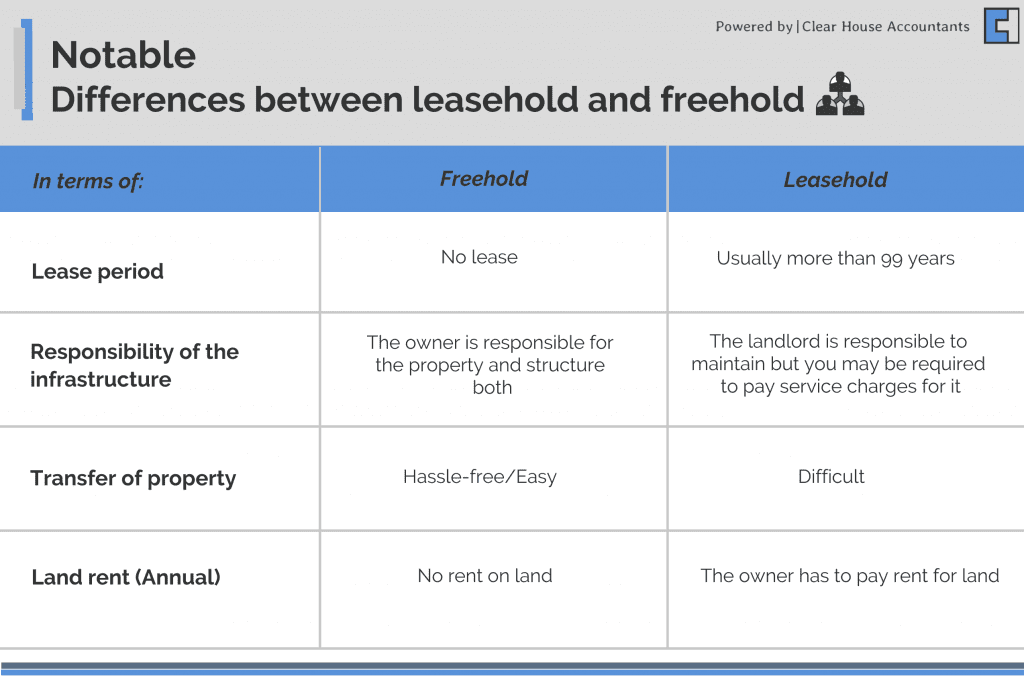
The following image illustrates the difference between leasehold and freehold:

| Leasehold Ownership | Freehold Ownership | |
Ownership
| Leasehold ownership allows one to enjoy ownership over the flat/house and not on the land it’s built on | Freehold ownership allows one to enjoy ownership over both the flat/house and the land it’s built on |
| Ownership duration | The lease has a set period, such as 99 or 125 years. | Ownership of the building is indefinite |
| Example | Flat/home owned in a private housing society | Building owned based on freehold ownership |
| Mortgage Loan | Financial institutions are doubtful in cases of leases, so acquiring mortgage loans is somewhat difficult | Financial institutions have greater trust due to freehold ownership, so it is easier to acquire mortgage loans |
| Ownership cost | Cheaper due to payment in instalments for the property | Relatively expensive because of high land prices due to the land being purchased on a freehold sale basis |
| Upkeep of property | The leaseholder bears no responsibility for upkeep of the property. They will pay for this via a service charge, which may also include ground rent. | The freeholder is responsible for the maintenance of the property |
| Property Insurance | The freeholder usually arranges building insurance | Freeholders must arrange their building insurance |
Understanding the difference between leasehold and freehold is important as it determines the rights and responsibilities that come with both the leaseholders and landlords. More crucially, it ensures the service charges are paid transparently by the leaseholders while the landlords properly maintain the building. To deal with the service charges effectively, relying on expert help always proves immensely helpful.
In this respect, Clear House accountants are professional, skilled Service Charge Accountants, with considerable experience in the service charge domain. Their service charge accountants work with landlords, property management companies, developers, and other stakeholders to help them prepare effective service charge accounts and outsource complete accounting. Thus, contact them today and start getting comprehensive accounting solutions with the experts.