




















































Apart from obvious bookkeeping and tax submissions, an expert account can help you manage multiple areas of the business. Having an accountant for your small business means year-round support and timely tax filings.
Regardless of a business’s stage in the business life cycle, the right accounting help makes it easier for small business owners to address cash flow challenges, manage marketing efforts, and improve sales without worrying about inaccurate books and submissions.
If you’re still contemplating whether you need a good accountant for your business, we have curated 9 reasons that a business accountant is essential for your business.
Does a Small Business Need an Accountant?
Yes, the majority of small businesses need an accountant who helps them remain tax-compliant, maximise reliefs, and avoid any unnecessary costs.
Since hiring an accountant is not legally required, most startups handle basic financial record-keeping, invoicing, tax filings, expense tracking, and regulatory compliance. However, there are certain risks in handling all tasks independently, for example, delayed submissions, missed due dates, inaccurate tax filings, penalties, cash flow difficulties, and unclaimed tax deductions.
If your business is expanding, employs staff, holds VAT registration, or deals with more complicated tax liabilities, an accountant can protect you from costly mistakes and help you save time.
Is Hiring an Accountant Worth It?
Yes, hiring an accountant is typically beneficial for entrepreneurs, stakeholders, or individuals navigating complex tax obligations. Various small business owners consider hiring an accountant as an added expense. Yet, their contributions generally justify the cost by enabling businesses to prevent mistakes, free up valuable time, and make smart business decisions.
An accountant plays an important role in supporting your business by:
- Avoiding liabilities caused by delayed submissions or improper filings.
- Managing taxes, salary payments, bookkeeping, and regulatory tasks by minimising work pressure.
- Spotting tax savings and claimable expenses that might otherwise be missed. You can manage your finances with expert Tax Services.
- Giving clearer insights into financial and business performance.
- Providing reliable financial guidance to help with growth and strategic planning.
Why Compliance Matters for Small Businesses
Compliance is one of the major factors that small businesses hire accountants. Handling timely submissions and legal obligations can be difficult, and inaccuracies can lead to financial losses. An expert accountant guarantees compliance in your business with all regulatory requirements.
For small businesses, core compliance responsibilities are:
- Company Tax Filings: Helps ensure correct filing and on-time submission of your business’s tax due payments to HMRC.
- VAT Obligations: Manages VAT compliance, filings, and payment obligations accurately to prevent financial penalties.
- Annual Accounts: Prepares and files annual accounts and financial reports with Companies House to meet all compliance regulations.
- Confirmation Statements: It tracks annual confirmation statements that are finalised on time and contain correct company information.
- Payroll Reporting & Compliance: Handles PAYE, RTI filings, and staff data to fulfil HMRC payroll standards.
- HMRC Submission Deadlines: Meet all regulatory filing, tax, and reporting deadlines to avoid late payment penalties.
An accountant keeps your business safe from compliance-related risks, enabling you to concentrate on growth and operational performance by managing these compliance responsibilities.
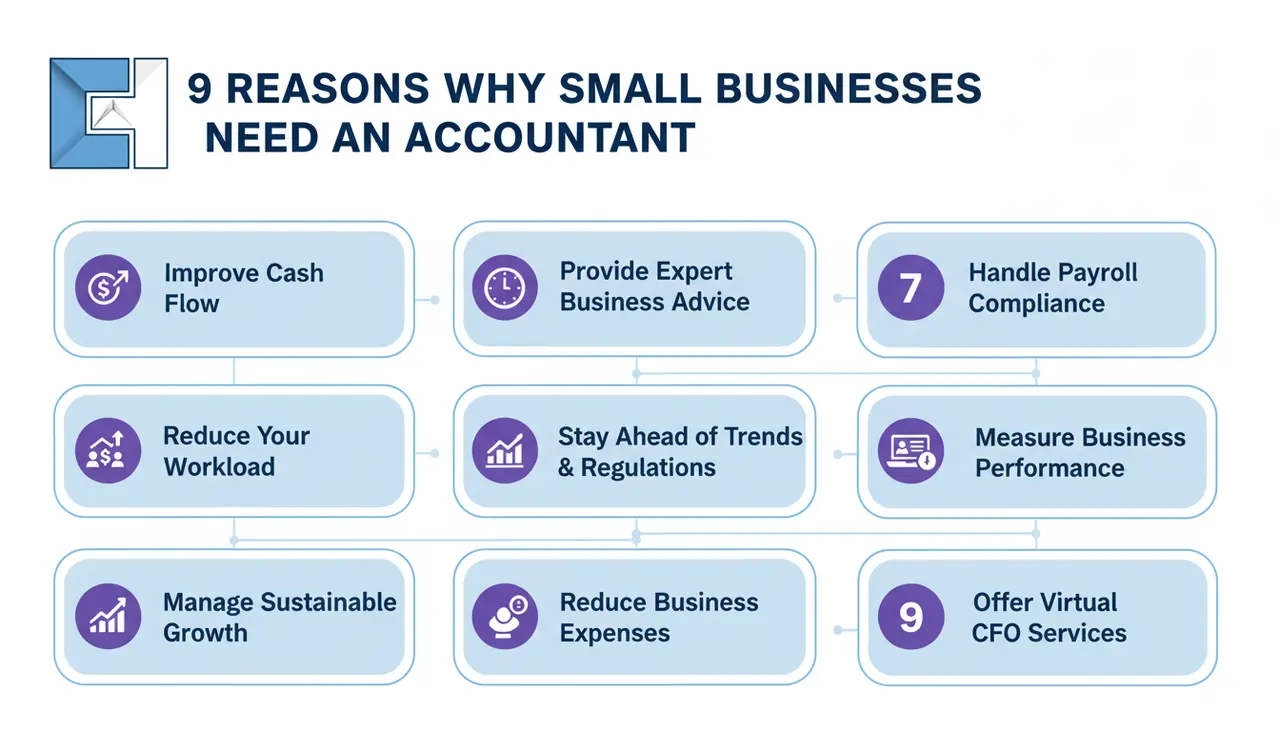
Reasons Small Businesses Need An Accountant
1. Improve Cash Flow for Long-Term Business Stability
Cash is the fuel that keeps your business running. Without proper control of your cash flow, you will not be able to make critical decisions to run or grow your small business. Cash flow management is very important for your business; even a highly profitable business without sufficient cash will soon collapse.
To help you better understand and manage your cash flow, we have curated an effective cash flow guide.
Hiring a good accountant will ensure that you have good credit control and cash management policies in place so that you have all the possible funds and information available to you.
Effective cash management involves how a company manages its operations, financial investments, and financing to maintain positive cash flow.
A company should generate adequate cash flow to cover its expenses, repay investors and expand the business. In addition to generating cash from its activities, a business needs to manage its cash to ensure it holds the right amount to meet its immediate and long-term needs.
2. Optimising Workload Management for Operational Efficiency
Once your business takes off, you’ll need all your time to run day-to-day operations rather than be occupied with compliance, tax or bookkeeping. Similarly, as the business finances become more complex, you’ll almost certainly need a specialist to take charge of them.
Hiring a small business accountant will help you manage operations by recommending process improvements, taking over the financial and tax obligations and introducing you to tools that can help you save time while also saving you money.
Struggling with your accounts and tax returns? Read our guide to learn how effective bookkeeping is crucial to monitor your cash flow, taxes, finances, and the robustness of your business.
3. Enabling Sustainable Growth for Small Businesses
A growing business requires timely, data-driven decisions to meet funding requirements, hire the right team, manage cash flow, and improve customer relations.
Having an expert accounting team supporting your business adds great value when seeking funding and creating incentivising pay packages for employees.
As good as the word growth sounds, it comes with its own challenges. Sudden growth that you haven’t planned for can be as problematic as growth that is too slow. Accountants help you react quickly and effectively to unexpected growth and turn it into what it should be: an advantage.
As a business owner, you must learn how to do employee recruitment effectively by reading this in-depth guide.
4. Financial Guidance at the Right Time
Another reason small businesses need an accountant is their expertise in business advisory services, which provide timely financial advice when it matters most. Accountants with industry expertise would have worked with businesses facing similar problems that your business would be facing.
With their problem-solving skills, they provide bespoke solutions tailored for your business that you might overlook due to a lack of experience or understanding of your current financial situation and future projections.
The financial guidance means unbiased, clear, and data-driven solutions, transparency towards potential risks and latent opportunities.
Moreover, their partnership network will add further value to your business decisions by helping you connect with key contacts who can help you implement proven strategies to solve complex problems.
Explore how business decisions affect your business growth and how to make better decisions in this guide.
5. Staying Ahead of Industry Trends and Regulatory Changes
With the right tools and data analytic skills, an accountant helps you visualise major issues the business faces due to economic uncertainties, evolving trends and new regulations that might be in the pipeline.
Through regular health checks and by comparing your business’s financial and economic performance with industry benchmarks, they identify opportunities to improve compliance and avoid penalties.
Learn how cash flow forecasting stabilises your business’s financial position by providing a clear picture of its liquidity, and explore cloud accounting in these guides.
6. Improving Cost Efficiency for Small Businesses
An advisory-led accountant can help you reduce your business expenses through cost structure analysis, margin and profitability review, benchmarking for contracts and market comparison.
Further cost reductions can be achieved through tax deductions for allowable expenses, which should be done properly through smart tax planning to avoid penalisation. Being tax-literate is important, and the gap in knowledge may put business owners in legal trouble.
Optimising the cost-effectiveness of the business also helps with business valuation if you are planning on selling the business. An accountant ensures you sell your business tax-efficiently.
Learn how to achieve success in financial management, save taxes when selling your business, and how an accountant can be a saviour for your business’s success in these guides.
7. Managing and Streamlining Payroll
Businesses with employees need to operate payroll effectively and in line with payroll regulations. Not doing payroll right can result in fines, unhappy employees and huge backdated tax bills.
Specialised payroll accountants help you streamline and manage the process from submitting RTI, managing payroll records and final submission to HMRC.
Explore what payroll is and how its meaning can vary across contexts. This article will help you with payroll compliance.
8. Business Performance Tracking for Informed Decisions
Businesses frequently overlook performance measurement. Establishing key performance indicators (KPIs) and benchmarking them against actual outcomes, such as customer acquisition rates, revenue growth, complaint volume, and invoice write-offs, is pivotal in determining a business’s viability. SaaS business metrics offer a proper method to measure this performance accurately.
Many businesses struggle because they fail to consistently monitor financial and operational performance indicators.
An accountant helps develop performance evaluations using growth efficiency metrics such as the SaaS Magic Number. Using these evaluations, a business can understand its actual performance against the indicators it considers important for long-term growth and sustainability.

9. Offering Virtual CFO Services for Businesses
If your business is big enough to need the expertise of a CFO but isn’t big enough to hire one full-time, you need to look at virtual CFO services. This provides you with the expertise of a CFO at your fingertips, at a cost within your budget.
A good CFO will help you set effective financial controls, a management accounting process, help manage investor relations, review business plans, provide unbiased financial and business advice, set an effective budgeting and forecasting process, help with strategic planning, cash management, and help set effective reporting for the business, which is mainly important when considering the role of CFO in technology businesses.
Learn how to prepare management accounts and budget for the financial success of your business with these guides.
Bottom Line
Undoubtedly, a professional accountant can add significant value to your business in several ways. By making financial reporting clearer and ensuring correct submissions, they help you make better business decisions, minimise financial risks, and support sustainable growth.
With a primary focus on productivity, compliance, and long-term stability, an accounting professional serves as a reliable advisor who strengthens your financial foundation and supports steady business performance.
They also ensure full HMRC regulatory compliance while helping to avoid preventable tax charges through strategic tax planning. In addition, they provide clear business performance insights, so you can grow your business with confidence and save valuable time.
Whether you need assistance with taxes, filings, bookkeeping, or payroll, or are searching for a reliable financial partner to enhance performance and profitability, our small business accountants provide strategic, trustworthy financial guidance designed to meet your business needs.