



















































Advisory fuel rates are HMRC’s recommended mileage rates for employees using company cars. Employers can use these rates to reimburse business mileage or calculate how much employees must repay for fuel used on private journeys in company cars. The business needs appropriate VAT evidence and mileage records to reclaim VAT, as reimbursement does not automatically establish entitlement to reclaim VAT.
For VAT purposes, VAT-registered businesses may use the relevant advisory fuel rate to calculate the VAT element of qualifying business mileage in a company car, subject to the applicable VAT rules. Businesses using the Flat Rate Scheme generally cannot reclaim VAT on fuel purchases in this way.
We recommend that you speak to a qualified VAT accountant to help you choose the best VAT scheme for your business.
You can use advisory fuel rates to help you calculate:
- The fuel element used to calculate VAT recoverable on qualifying business mileage allowances, subject to the relevant VAT rules and supporting records.
- The amount employers can reimburse employees for business travel in company cars.
- The amount employees must repay their employers for private fuel used in company cars.

What are the Advisory Fuel Rates in 2026?
HMRC’s advisory fuel rates below apply from 1 September 2026.
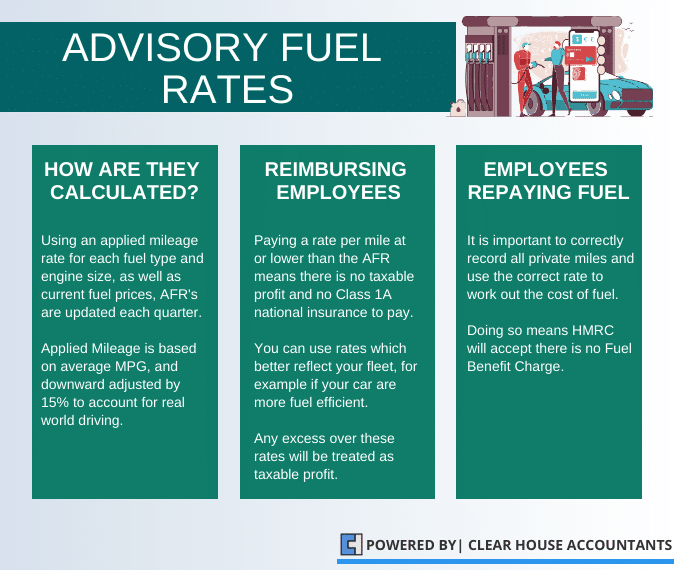
If an employer reimburses an employee for business travel in a company car at a rate no higher than HMRC’s applicable advisory fuel rate, there is no taxable profit and no Class 1A National Insurance to pay on that reimbursement.
Learn more about National Insurance and when it is applicable, and speak to our tax accountants, who are specialists in National Insurance.
HMRC Advisory Fuel Rates 2026 (Applicable from 1 September 2026)
Engine size/charging method | Petrol | Diesel | LPG | Electric |
1,400cc or less | 14p | NA | 11p | — |
1,401cc–1,600cc | 17p | 15p | 13p | — |
1,601cc–2,000cc | 17p | 16p | 13p | — |
Over 2,000cc | 27p | 22p | 20p | — |
All engine sizes — home charging | — | — | — | 7p |
All engine sizes — public charging | — | — | — | 15p |
Video: What car expenses can you claim?
Watch the video to learn all about car expenses and how you can claim them.
Reclaiming VAT on Fuel for a Company Car
George travels 80 miles on a business trip in his 2,500cc diesel company car. He has purchased £50 worth of fuel for the vehicle.
Using HMRC’s advisory fuel rate of 22p per mile, the fuel element for the 80 business miles is £17.60 (80 × 22p). If the relevant VAT recovery conditions are met, the VAT element at the standard rate of 20% is £2.93 (£17.60 × 1/6).
The business must retain the required fuel invoices and mileage records to support its claim. The £50 fuel purchase alone does not determine the amount of VAT that can be reclaimed.
Claiming Mileage on a Company Car
Charles uses his 2500cc diesel company car for 450 business miles. Using the advisory fuel rate of 22p per mile, the employer can reimburse him £99 for fuel costs (450 × 22p), without creating a taxable profit or Class 1A National Insurance liability, provided the reimbursement does not exceed the applicable advisory rate.
Repaying an employer for private fuel
Emma drove her 1650cc diesel company car for 150 private miles. Using the advisory fuel rate effective from 1 September 2026, her private-fuel repayment is £24.00.
Not all circumstances are straightforward; we advise you to speak to our expert, qualified accountants, who can help you with any and all VAT-related questions and issues.
Need Help Managing Company Car Fuel and VAT?
Whether your employees use petrol, diesel, hybrid or fully electric company cars, applying the correct advisory fuel rates and maintaining accurate mileage and fuel records is important. Hybrid cars follow the relevant petrol or diesel advisory rates, while fully electric cars have separate rates for home and public charging.
Our VAT Services can help your business understand the VAT treatment of company-car fuel, assess whether VAT can be recovered and apply the appropriate VAT rules.