







































When filing the self-assessment tax return, self-employed individuals can reduce their tax liability through certain tax reliefs and tax-deductible expenses. Additionally, HMRC helps business owners calculate some of their allowable expenses in a simplified manner. This guide provides an overview of HMRC simplified expenses for the self-employed, including what they are, how to claim them, and who is eligible to use them.
What Are Simplified Expenses?
HMRC simplified expenses are a way for self-employed individuals to calculate some of their allowable expenses using flat rates to claim tax relief for them. Simplified expenses are often referred to as the flat rate method as well. This system allows calculating these expenses using fixed ‘flat rates’ instead of keeping detailed records and precisely calculating the business proportion of each cost. Self-employed individuals must compare simplified flat rates with actual costs to determine which offers the greater tax deduction, as flat rates aren’t always the most financially advantageous.
Who Can Use HMRC Simplified Expenses?
Simplified expenses are used by self-employed individuals, including:
- Individuals working as sole traders
- Self-employed working in business partnerships, provided that they do not have another company as their partner.
As stated earlier, simplified expenses help calculate some of the allowable business expenses using flat rates, but not all. However, there are several tax reliefs and deductions that self-employed individuals can claim to reduce their self-assessment tax bill. Learn what they are:
Tax Reliefs And Deductions To Claim For Self-Assessment?
Who Cannot Use Self-Employed Simplified Expenses?
Importantly, businesses that cannot use simplified expenses include:
- Limited companies
- Business partnerships that involve one of the partners as a private or public limited company.
Since HMRC provides flat rates to calculate self-employed business expenses, individuals should use the HMRC simplified expense rate checker to see whether they can save money using simplified rates, or they should instead calculate the actual costs.
What Business Costs Do Simplified Expenses Cover?
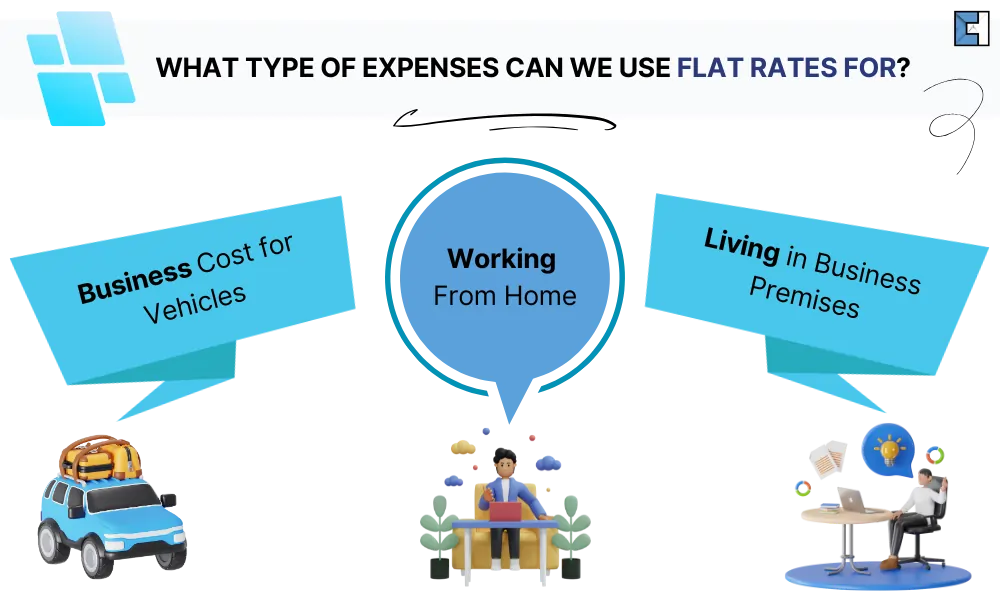
Notably, not all the allowable expenses can be worked out through the flat rate method, as they are for certain business expenses, such as:
- Vehicles used for business purposes
- Expenses incurred when working from home
- When living at the business premises.
How to Calculate Business Vehicle Costs Using Simplified Expenses?
Using simplified expenses, self-employed individuals can work out their business vehicle expenses using a flat-rate mileage allowance. As a result, they are not required to calculate the actual costs associated with purchasing and operating their vehicle, such as fuel, insurance, repairs, and servicing.
Notably, not every vehicle is eligible for a flat-rate mileage allowance. The simplified expenses can be used for the following vehicles:
- Cars, excluding commercial-use vehicles, such as black cabs, and dual-control driving instructors’ cars
- Goods vehicles, like vans
- Motorcycles.
To calculate vehicle costs incurred for business purposes, the number of miles the vehicle travels is multiplied by the flat rate that can be claimed.
The following table shows the flat rates per mile that the vehicles can use with simplified expenses:
| Vehicle | Flat rate per mile with simplified expenses |
| Cars and goods vehicles (travelling first 10,000 miles) | 45p |
| Cars and goods vehicles (after 10,000 miles) | 25p |
| Motorcycles | 24p |
Calculating Work-From-Home Costs Using Simplified Expenses
Self-employed individuals can use simplified working-from-home expenses by applying the flat-rate method based on the hours they work from home every month. Hence, under a flat-rate method, an individual does not need to use the apportioned-cost method to calculate the proportion of personal and business use of their home.
Furthermore, under a flat-rate method, a person can calculate their allowable work-from-home expenses based on the hours they work from home per month.
The following are the flat rates to claim based on the working hours per month:
- If a person works from home for 25 to 50 hours each month, they can claim a fixed amount of £10
- For 51 to 100 hours, £18 per month is claimable
- For 101 hours or more, £26 per month is allowable.
Note that a self-employed individual can only use simplified working-from-home expenses if they work from home for 25 hours or more per month.
How to Claim Simplified Expenses When Living at the Business Premises?
These simplified expenses apply to a small number of individuals who use or live at business premises as their home, such as people living in their own guesthouse, bed and breakfast or small care home. Now, under the flat-rate method, they are entitled to use simplified expenses rather than computing the exact split between their personal and business costs for their premises.
First, they will calculate the total expenditure for the premises. Next, using the flat rates, they will simply subtract the amount spent for their personal use of the premises. Primarily, the claimable amount is based on the number of people living on the premises, as illustrated in the table below. The remaining amount can then be claimed as their business expenses.
| Number of people | Flat rate per month |
| 1 | £350 |
| 2 | £500 |
| 3+ | £650 |
How to Use Simplified Expenses for the Self-Employed?
In order to claim HMRC self-employed simplified expenses, individuals must:
- Maintain accurate records of their business miles for vehicles, hours they work at home, and the number of people living on their business premises throughout the year.
- When the tax year ends, they will use the flat rates provided by HMRC to calculate the simplified expenses for vehicle mileage, working from home, and living at business premises.
- Next, they will add these calculated amounts to the total figure of simplified expenses.
- Lastly, by subtracting the total amount of the simplified expenses from their taxable profit, they can claim relief in their Self-Assessment tax return.
While simplified expenses for the self-employed help claim tax relief, there are other crucial aspects associated with a self-assessment tax return. For instance, self-assessment forms, important deadlines, and the criteria for filing the tax return. Read the following guides to learn the fundamentals of self-assessment tax returns:
Do Simplified Expenses Add Any Value To Business?
It is important to note that not every self-employed person needs to use HMRC simplified expenses because they are optional. It all depends on what works best in claiming maximum tax relief and suits their business. Otherwise, they can calculate actual costs in detail if it will help them claim larger tax deductions. However, using simplified expenses not only allows fixed rates to be used but also reduces the administrative responsibilities, such as calculating the costs manually in detail.

Summary
In brief, under the flat-rate method, self-employed individuals can calculate their three allowable deductions using simplified expenses and claim tax relief when filing their self-assessment tax return.
Speaking to a skilled self-employed accountant before deciding to implement a certain method for calculating business expenses can be greatly beneficial, as they can help you claim maximum tax relief with their expert guidance.
Also, with error-free online self-assessment tax services, you can file your tax return on time and stay compliant.
FAQs
What is a simplified expense?
Self-employed simplified expenses are a way to calculate certain business allowable expenses using flat/fixed rates rather than computing your actual business costs. These simplified expenses help you claim tax relief on your self-assessment tax return.
What are the three types of simplified expenses?
Under HMRC simplified expenses for the self-employed, you can use flat rates to calculate the costs of:
- Vehicles used in your business.
- Working from home.
- Living in your business premises.
Do simplified expenses include council tax?
No, HMRC simplified expenses do not include the council tax. It is because under the simplified working-from-home expenses, you can use flat rates depending on the number of working hours from home per month. It means you do not have to calculate the proportion of personal and business use for your home, which includes electricity, heating, council tax, mortgage interest or rent, internet, or telephone use.
What is the simplified home office expense?
Under simplified work-from-home expenses, you can use your home as your work space and calculate your allowable expenses using a flat rate based on the hours you work in the home office every month.