







































Being self-employed offers numerous advantages, such as being your own boss as a sole trader or freelancer, flexible working hours, the freedom to work from anywhere, and unlimited financial opportunities. However, with infinite autonomy of being self-employed comes a few significant liabilities as well. One of the crucial responsibilities you cannot escape is filing your self-assessment tax return.
However, there are certain tax reliefs and deductions to claim for self-assessment, for the self-employed, which can considerably bring down your tax bill. This guide will inform you of the tax reliefs and self-assessment tax reliefs and deductions that you can claim from HMRC when filing your self-assessment tax return. This is not exhaustive and covers the most prominent ones.
The Application of Tax Relief when Filing a Self-Assessment?
Tax relief is a reduction that you can apply to your taxable income through deductions, claims and exemptions. You can enjoy tax relief through several self-assessment tax allowable deductions.
Notably, allowable expenses, often referred to as tax-deductible expenses, are the costs that you can subtract when working out your taxable profits. As a result, you will exclude these costs from your total earnings before paying Income Tax.
If your annual turnover is £50,000 and you claim £15,000 in allowable expenses, then your taxable income would be £35,000.
Not everyone is obligated to submit a self-assessment tax return. Find out whether you fall under the criteria set by HMRC.
Key Considerations When Claiming Deductions For Self-Employment
When discussing claimable self-assessment tax reliefs and deductions, it is vital to note that HMRC does not grant tax reliefs out of its generosity; in fact, you can exclude or subtract the allowable costs from your total earnings before paying Income Tax, as long as they are allowable expenses and were used wholly and exclusively for work purposes.
What Tax Reliefs And Deductions To Claim For Self-Assessment?
The following are the tax reliefs and deductions you can claim as a self-employed individual from HMRC to reduce your tax bill:
Claim Pension Contributions
Contributions to your pension are not business expenses, as they serve as personal savings for your retirement. It means they do not directly affect your self-employed profits. However, you can still benefit from the tax relief on your pension contributions on your income tax rate.
The self-employed pension contributions tax relief will be applied automatically, or you will have to claim it yourself. It is based on what type of pension scheme you are a part of and the income tax rate you pay.
For instance, if you are a basic-rate (20%) taxpayer, your pension provider automatically claims the first 20% relief (relief at source) from the government and adds it to your fund.
Likewise, if you are a higher or additional-rate taxpayer, you can claim an additional 20% or 25% tax relief, respectively, via your self-assessment tax return.
Claim Self-Assessment Allowable Expenses
You can reduce your taxable income by claiming allowable expenses. It is important to understand that allowable costs cannot be claimed if HMRC finds any spending on personal expenses.
Office Equipment Costs
All expenses that you incur while making purchases for essential office equipment are tax deductible, including laptops, PCs, printers, printer ink and computer software that have been in business use for less than two years, along with any cost incurred on stationery items like pens, holders, printing and postage, envelopes, etc.
Communications
Businesses have seen an upward trend in operating online, post-pandemic. Hence, the costs associated with electronic communications are also allowable, such as self-employed phone expenses, business mobile usage, and internet bills.
Marketing
All the costs associated with advertising and marketing your business or services, including the costs incurred on purchasing a website domain and hosting your business website, are claimable.
Staff Costs
If your business requires hiring staff, there will be several costs and obligations involved. For instance, their incomes, National Insurance (NI) and pension contributions, bonuses, payments to subcontractors, holiday and sick entitlements. Fortunately, these are deductible when working out the profits of the business.
Training And Education Costs
Costs for workshops directly related to business, relevant periodicals, or educational events aimed at enhancing employees’ vocational skills are tax-deductible as self-employed training expenses.
Clothing
Some businesses require staff to wear uniforms and specialised protective clothing like steel-toe boots, industrial-grade eye protection, helmets, etc. The expenses for work-related special clothing fall under the allowable clothing expenses for the self-employed.
Professional Insurance And License Renewal Fees
Expenses for professional insurance and costs for obtaining or renewing professional licenses can be claimed back.
Professional And Financial Services Costs
To ensure your business runs smoothly and your tax returns are filed effortlessly, you should get professional help. Any costs incurred on the fees paid to these professionals are allowable deductions for the self-employed.
Business Vehicle Use
When using a vehicle exclusively for business, you can claim back the costs.
- Vehicle Insurance
- Repairs And Servicing
- Fuel
- Parking
- Hire Charges
- Vehicle Tax Licence Fees
- Breakdown Cover
You can calculate and claim the business costs separately or simplify the total cost by claiming the HMRC mileage allowance.
Self-Employed Mileage Deduction
HMRC’s self-employed mileage allowance is a flat-rate method under the simplified expenses scheme. The allowance helps you reduce your tax liabilities by calculating the vehicle running costs based on mileage. You can claim self-employed flat rate expenses for:
- Cars
- Goods vehicles like vans
- Motorcycles
Additionally, the following guide can elaborate on how to use simplified expenses and whether they actually add any value to your business:
Business Travel Expenses
You can claim travel expenses for self-employed from HMRC, provided you are travelling solely for the cause of your business. Notably, allowable travel expenses include:
- Train, bus, tram, air and taxi fares
- Accommodation costs/ hotel room charges, given that you are staying for business operations
- Cost of food on overnight business trips
You must file a Self Assessment with HMRC if your annual income exceeds £1,000. Learn what self-assessment forms you can use in the process and the important deadlines:
Claim Capital Allowance
When you purchase a business asset which will benefit the business financially in the long run, you can claim these expenses as a capital allowance, which helps you reduce your tax liability.
Learn what assets can be claimed under capital allowance to reduce your tax bill.
Do you know the procedure to claim capital allowance on your capital assets?
Refer to the guide to learn the steps involved:
Claim Self-Employed Expenses When Working From Home
You can claim self-employed home office expenses to reduce your tax bill if you work from home. Notably, there are two ways you can claim a self-employed work-from-home allowance:
Flat Rate Method
You can compute your tax-deductible expenses via a flat rate based on the hours you work from home per month. For instance, if each month, you work from home for 25 to 50 hours, you can claim a fixed amount of £10.
Apportioned Costs Method
In this method, you can claim back a proportion of the following based on the space you need to use for your business, such as:
- Electricity
- Heating
- Council tax
- Mortgage interest or rent
- Internet
- Telephone use
You can split the above-mentioned bills based on the number of rooms you use for business or the time you spend working from home to claim back a realistic amount.
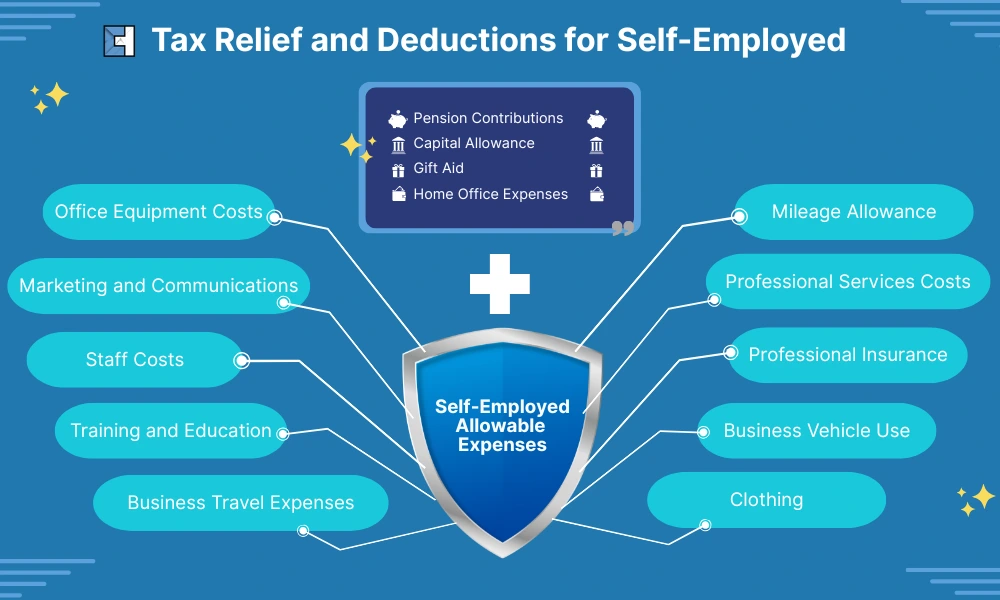
Gift Aid benefit to Charities
Making donations to charity not only supports a noble cause but is also another important way to get tax relief and lower your tax bill.
If you make a charity donation through Gift Aid, whether it is in the form of shares, property, land, or cash, you can make a Gift Aid charity claim of up to 25% tax relief, i.e., for £100 to a charity through Gift Aid, the charity can claim an extra 25p for each pound. Consequently, your total donations reach £125 at no additional cost.
In addition, if you are a high-rate or additional-rate taxpayer, you can claim back the difference between your rate and the basic rate on your self-assessment tax return.
To understand charity tax relief on how high-rate taxpayers claim relief you can read more:
Conclusion
By understanding tax reliefs and deductions for the self-employed, you can significantly reduce your tax liability. Nevertheless, those deductions must be for the running of your business rather than for personal use. But what happens if certain costs comprise both business and personal expenses? How to separate the two, then?
Our specialist Accountants for Self-Employed individuals at Clear House Accountants can offer help in filing your accurate online Self-Assessment tax returns. Simplify your financial management and alleviate your tax duties with the help of experts.
FAQs
What are tax reliefs and deductions for self-employed individuals?
Tax relief is a reduction that HMRC offers you to apply to your taxable income to lower your tax bill. The taxable income is the total amount you need to pay tax on.
What are the different tax reliefs for the self-employed?
Fortunately, there are several ways you can alleviate your tax burden, including pension contributions, claimable expenses for the self-employed, and charitable donations tax relief. These deductions play a vital role in relieving you from paying more taxes to HMRC by cutting your self-assessment tax bill.
How can you claim self-assessment allowable expenses?
In order to claim back allowable self-employment expenses, you must maintain accurate records of all your business expenses, which will serve as evidence of your running costs for business. You can provide the details of your allowable expenses for the tax year to HMRC on your Self-Assessment tax return. Take note that you are not required to submit the proof of expenses when submitting your tax return. However, maintaining them is strongly advised in case HMRC asks about them.
What records must be maintained to claim allowable expenses?
To ensure you can secure maximum tax benefits, you should keep all the invoices, bank statements, and receipts connected to your business expenses throughout the year. Using digital bookkeeping software can organise them far better and easier at tax return time.
How To Claim Tax Relief As A Self-Employed Individual?
For self-employed individuals, the easiest and most convenient way to claim the majority of their tax reliefs and allowable self-employment expenses is through filing a self-assessment. It is an online process where you mainly report your taxable income to HMRC and pay tax due on it by submitting the details of your earnings (income and profits) for the entire tax year.