









































HM Revenue and Customs (HMRC) reminds working parents in the UK to take advantage of the opportunity to earn up to £2,000 a year to pay for regulated childcare, including holiday clubs and other extracurricular activities, during the Easter holidays.
Thousands of eligible working families can get £500 every three months and £1000 if the child is disabled. Furthermore, this tax-free childcare is available for children aged 11 to 17 or with disabilities.
This tax-free care covers the additional cost of holiday clubs, childminders and nurseries, before- and after-school clubs, and other approved childcare schemes. It also covers England, Scotland, Wales, and Northern Ireland.
How Does This Childcare Scheme Work?
Firstly, Families have to deposit money into their tax-free childcare online accounts. Afterwards, they can utilise the 20% top-up for their childcare cost when needed. Also, parents or childcarers can open the accounts at any time of the year.
The child’s family will receive an additional £2 in their government top-up on every £8 deposit made to the account. Unused deposit money can be withdrawn at any time.
This scheme supports thousands of households, including working families and self-employed individuals who work hard to pay their bills and childcare costs.
With a considerable share of £34m of government top-up payments, about 328,000 working families in the UK had availed of this childcare scheme in December 2021. However, according to HMRC, only one in four families claims funds, even though there are 1.3 million estimated eligible families in the UK
You Only Need To Earn Under £100,000 Per Year.
To avail of this scheme, the minimum requirement is that the family earn £100,000 annually, regardless of whether one parent is working or both parents. Also, parents shouldn’t receive any tax credits, childcare vouchers, or Universal Credit.
However, there are certain conditions in which you’d still be eligible even if you are not working or earning £100,000 yearly. Those conditions include:
- When you are on sick leave.
- If you are on annual leave.
- When you are on shared parental, maternity, paternity or adoption leave.
- If you or your partner cannot work and receive certain benefits like carer’s allowance or severe disablement allowance.
What If I Am Self-Employed?
If you’re self-employed and earn at least £142 every week for the next three months or throughout the rest of the current tax year, you’ll qualify; you will be eligible for the childcare allowance. This does not apply to you if you’ve been self-employed for less than a year.
If holiday clubs are used during school holidays, parents can still deposit money into their accounts throughout that year and distribute childcare costs. Parents can use tax-free childcare support for childcare costs, including breakfast and after-school clubs.
Exchequer Secretary to the Treasury, Helen Whately, stated: “There are many brilliant holiday clubs and childcare providers to help working parents during the Easter holidays. This scheme is a great offer to help cut the childcare bills”. Furthermore, she stated that families across the UK should now sign up for this scheme and take advantage of this support and extra pounds.
However, Families with younger children have higher childcare costs than families with older children, so the tax-free savings can make a difference. Furthermore, parents and childcare providers can sign up for the scheme via this link to receive the payments.
To manage your income records correctly, especially when applying for schemes like this, see our complete guide on HMRC Self Assessment Forms | A Complete Guide.
Childcare Scheme And Childcare Vouchers — Which Is Better?
Tax-free childcare and childcare vouchers are government schemes that help individuals with childcare costs. However, Childcare vouchers are no longer available to new applicants. This voucher scheme was closed to new applicants in October 2018.
If you were signed up for vouchers before the scheme closed, you could continue to get them as long as you stay with the same employer and it still offers them. Also, it is not possible to use both schemes simultaneously. You and your partner must avail yourselves of the benefits of the same scheme. But what’s the difference between the two schemes?
Tax-Free Childcare
- The government administers it.
- Couples who earn less than £100,000 each are eligible for the scheme
- Tax-free childcare will continue to be available for the foreseeable future
- Best fit for Higher childcare costs
Childcare Vouchers
- Your employer administers childcare vouchers
- No income limit with childcare vouchers.
- Couples don’t need to pay the total income tax and national insurance.
- Best fit for lower childcare cost
- Understand your tax obligations better with our guide on How Much Income Tax and National Insurance to Pay.
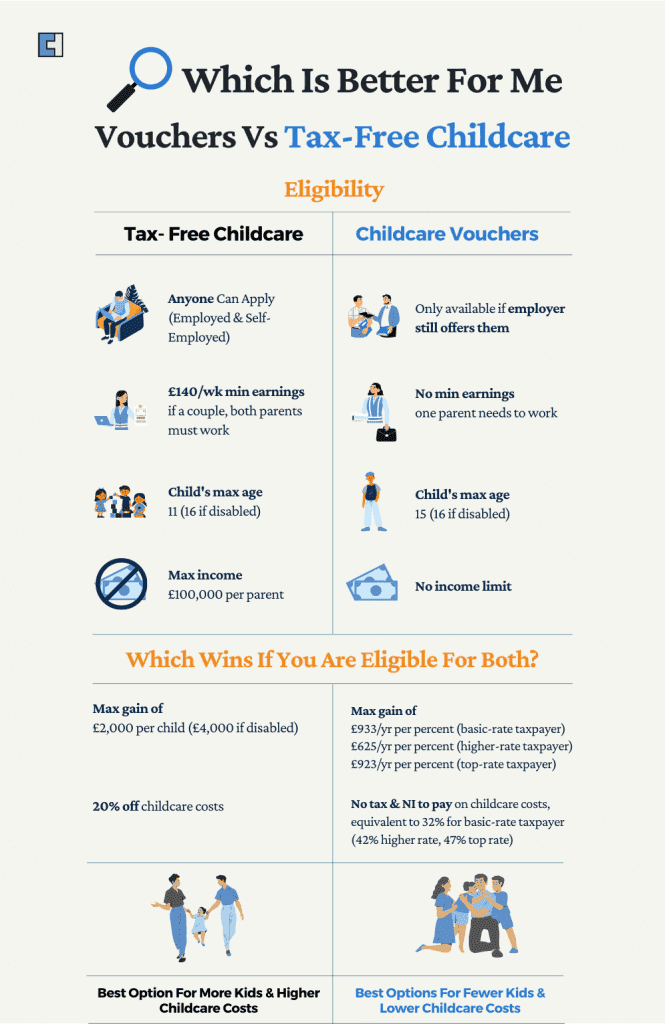
Using these schemes, you can use the childcare calculator to get an exact idea of how much you can save on childcare costs. It compares childcare vouchers, Tax-Free Childcare and Tax Credits.
I’m A Single Parent; Do I Qualify?
Yes, Single parents can also benefit from Tax-Free Childcare. Remember, your partner does not have to be the other parent – it depends on who you live with. If you move in with your new partner and they are not eligible for the scheme or do not meet the criteria mentioned above, then you can no longer claim Tax-Free Childcare. If you provide child maintenance to your partner, you might need to read our guide on child maintenance costs.