
















































Capital Gains Tax (CGT) planning can help investors, property owners, and business owners manage their tax liabilities when disposing of assets. Planning before a disposal can provide opportunities to use available allowances, losses and reliefs, as well as consider the timing and structure of a sale.
For the 2026/27 tax year, individuals should consider the current CGT rates and available reliefs when planning disposals. This is particularly important for business owners, as the Business Asset Disposal Relief (BADR) rate increased to 18% from 6 April 2026.
This guide explores Capital Gains Tax planning strategies that individuals and business owners can consider in 2026, including the Annual Exempt Amount, transfers between spouses and civil partners, ISAs, capital losses, property reliefs and business disposal reliefs.
Do you find it hard to understand how changing thresholds impact your tax liability? Read our detailed guidance on the current rules.
How to Reduce Capital Gains Tax in the UK
Reducing Capital Gains Tax (CGT) in the UK involves using legitimate tax planning methods to manage taxable gains. This can include using the Annual Exempt Amount, claiming allowable costs and reliefs, using capital losses, and considering the timing of asset disposals.
Individuals may also consider transferring assets between spouses or civil partners, using tax-efficient investments, and reviewing the reliefs available before a sale. Planning the timing of a disposal can be an important part of reducing unnecessary CGT exposure.
Learn more about how Capital Gains Tax is calculated, reported and paid in our complete CGT guide.
Capital Gains Tax Planning Strategies for 2026
1. Use Your Annual Capital Gains Tax Allowance
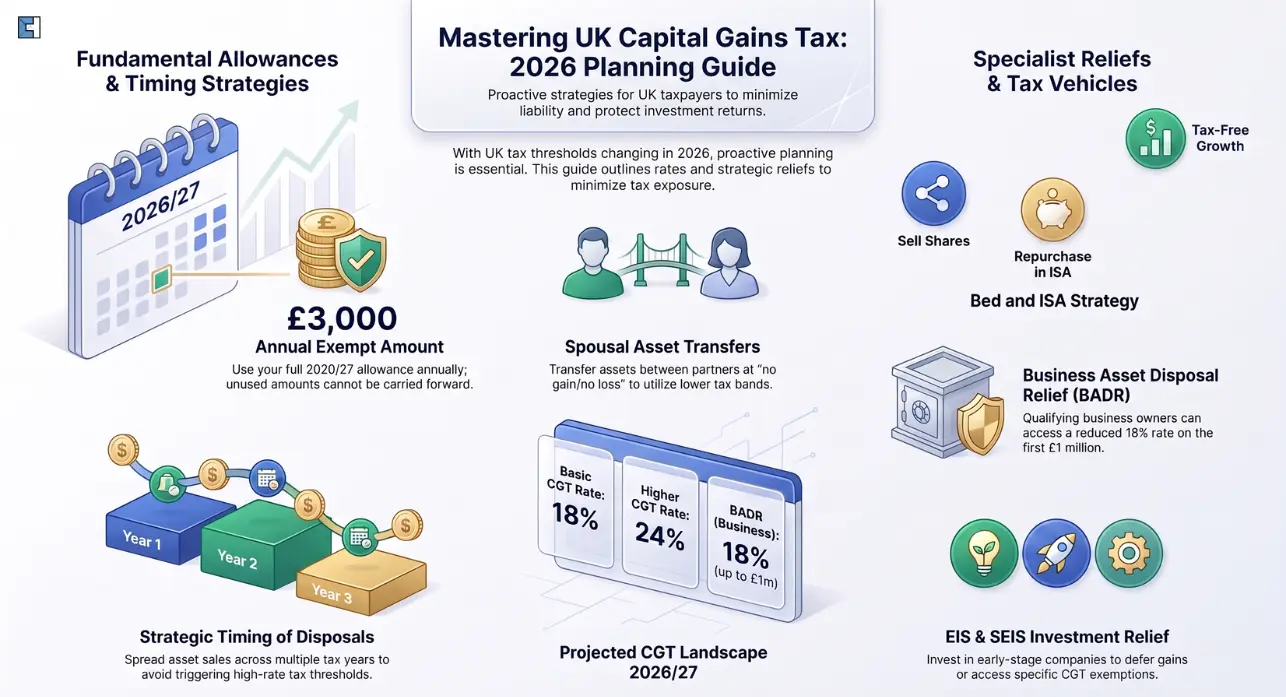
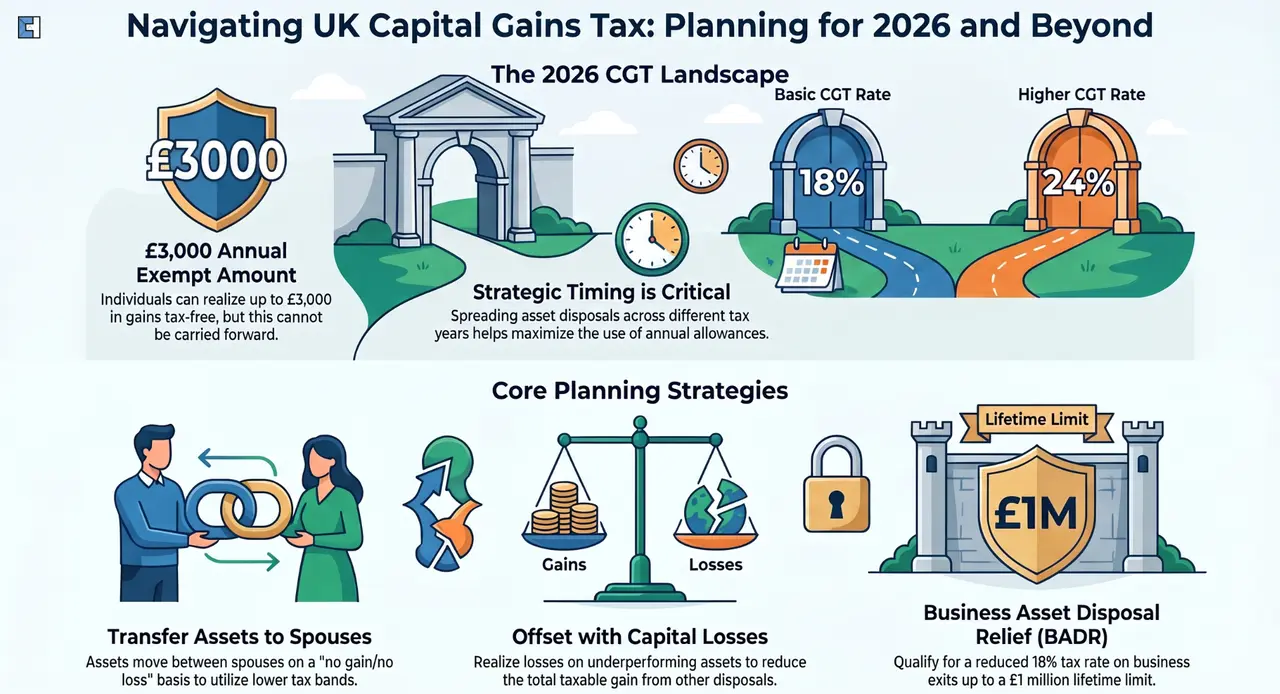
The Annual Exempt Amount provides that individuals can realise a set amount of gains without triggering a Capital Gains Tax liability. For the tax year 2026/2027, the allowance will be £3,000.
The allowance for any given tax year cannot be carried forward. Taxpayers should, therefore, be proactive with their tax planning. This is particularly useful for taxpayers who hold shares, as disposals can be spread over several tax years.
2. Transfer Assets Between Spouses or Civil Partners
Transfers of assets between spouses and civil partners who are living together are generally made on a no gain/no loss basis for CGT purposes. This means that an immediate CGT charge does not normally arise when the asset is transferred.
Transferring ownership before a future disposal may allow couples to make more effective use of both individuals’ Annual Exempt Amounts and available income tax bands, potentially reducing the overall CGT liability.
For example, transferring part of an investment to a spouse who has more of their basic-rate band available could result in part of a subsequent gain being taxed at a lower CGT rate.
Any transfer should be genuine and should be considered before the asset is sold, or binding disposal arrangements are put in place.
3. Bed and ISA Strategy for Share Investments
A Bed and ISA strategy involves selling investments held outside an ISA and repurchasing investments within an Individual Savings Account, subject to the investor’s available ISA subscription allowance.
The initial sale outside the ISA remains a disposal for CGT purposes and may therefore create a taxable gain. However, investors may be able to use their Annual Exempt Amount or available capital losses when calculating the CGT position.
Once investments are held within an ISA, income and capital gains generated within the ISA are generally exempt from UK Income Tax and Capital Gains Tax. ISA rules can change, so investors should check the latest HMRC guidance for current rules, including any rules affecting cash held within investment ISAs.
4. Use Tax-Efficient Pension Investments
Registered pensions can also provide a tax-efficient environment for investments. Investments held within a registered pension scheme can generally grow without Capital Gains Tax being charged on gains realised within the pension fund.
Pensions are subject to separate contribution, access and tax rules, so they should be considered as part of wider financial and retirement planning rather than solely as a CGT strategy.
5. Consider Timing When Selling Assets
The timing of an asset disposal can affect the amount of CGT payable because CGT rates can depend partly on the individual’s taxable income for the tax year.
Where a taxpayer expects their taxable income to be lower in a future tax year, delaying a disposal may mean that more of a taxable gain falls within the basic-rate band and is taxed at the lower CGT rate.
Where several assets are being sold, disposals may also be spread across different tax years where commercially appropriate. This can potentially allow taxpayers to use more than one year’s Annual Exempt Amount and manage the interaction between their income and capital gains.
CGT planning should therefore be considered before a disposal rather than after the transaction has already taken place.
6. Plan Ahead for CGT on Property
Selling a second home, buy-to-let property or other investment property can result in a Capital Gains Tax liability where a chargeable gain arises. Planning before the disposal can help ensure that all available costs and reliefs are considered.
Claim Eligible Property Costs: Keep records of qualifying acquisition, improvement and disposal costs, as these may be deductible when calculating the taxable gain. Routine repairs and maintenance will generally not qualify as enhancement expenditure.
Consider Ownership Structure: Couples may consider how a property is owned before a future disposal, as ownership can affect how gains, exemptions and tax bands are used. Any restructuring should be considered carefully before the sale.
Understand Private Residence Relief: Where a property has been the owner’s only or main residence during some or all of the ownership period, Private Residence Relief may reduce or eliminate part of the taxable gain, subject to the qualifying conditions.
7. Consider Business Asset Disposal Relief When Selling a Business
Business owners planning an exit should consider whether their disposal may qualify for Business Asset Disposal Relief (BADR).
For qualifying disposals made from 6 April 2026, the BADR rate is 18%, with a £1 million lifetime limit on qualifying gains.
As the standard CGT rate can be 24%, BADR may reduce the tax payable on qualifying business disposals.
BADR can apply to certain disposals of a business or part of a business, shares or securities in a qualifying personal trading company, and certain associated business disposals. Detailed qualifying conditions and ownership requirements apply, so eligibility should be reviewed before the disposal takes place.
8. Consider Employee Ownership Trusts as a Business Succession Strategy
For business owners considering succession, selling a controlling interest in a trading company to an Employee Ownership Trust (EOT) can provide an alternative to a traditional third-party sale.
For qualifying disposals made on or after 26 November 2025, EOT relief applies to 50% of the qualifying gain, rather than providing full CGT relief. The remaining 50% of the gain is chargeable to Capital Gains Tax.
EOT transactions are subject to detailed qualifying conditions, including requirements relating to the company’s trading status, the controlling interest acquired by the EOT and how the trust operates for the benefit of employees.
Business owners considering an EOT should therefore compare the tax consequences with other exit routes before proceeding.
9. Limit CGT by Using Capital Losses
Allowable capital losses can be used to reduce taxable capital gains and can therefore form an important part of CGT planning.
Where an investor disposes of an asset for less than its allowable cost, the resulting capital loss may be available to offset chargeable gains. Allowable losses arising in the same tax year are generally set against gains when calculating the taxpayer’s net gains for that year.
Unused allowable losses may also be carried forward and used against gains in future tax years, subject to the relevant rules.
Taxpayers should maintain appropriate records of capital losses and ensure that losses are claimed or notified to HMRC within the applicable time limits so they remain available for future use.
10. Consider EIS and SEIS Investment Reliefs
The Enterprise Investment Scheme (EIS) and Seed Enterprise Investment Scheme (SEIS) provide tax incentives for individuals investing in qualifying higher-risk companies.
For CGT planning, EIS may allow an existing capital gain to be deferred where the relevant conditions are satisfied and the gain is reinvested in qualifying EIS shares.
SEIS provides a separate CGT reinvestment relief, which may exempt part of an existing gain where qualifying gains are reinvested in eligible SEIS shares, subject to the applicable conditions and limits.
Qualifying gains arising on the EIS or SEIS shares themselves may also be exempt from CGT where the relevant requirements, including the qualifying holding period and Income Tax relief conditions, are satisfied.
EIS and SEIS investments involve significant investment risk and should not be entered into solely for their tax advantages.
11. Consider Gift Hold-Over Relief
Gift Hold-Over Relief may allow CGT arising on certain gifts or transfers of qualifying assets to be deferred.
Instead of the person making the gift paying CGT immediately on the full gain, the qualifying gain is generally deducted from the recipient’s acquisition cost. This effectively postpones the gain until the recipient later disposes of the asset.
The relief is available only in specific circumstances, including certain gifts of business assets and other qualifying transfers, so the conditions should be reviewed before an asset is gifted.
12. Consider Gifting Assets to Charity
Gifts of qualifying assets to charities can receive favourable Capital Gains Tax treatment. In many cases, an individual will not have to pay CGT when land, property or shares are donated to charity, although special rules can apply where an asset is sold to a charity for more than the donor originally paid.
Individuals considering substantial charitable gifts should review the CGT and Income Tax consequences before making the transfer.
Capital Gains Tax Rates and Allowances 2026
Understanding Capital Gains Tax (CGT) rates is very important when planning an asset disposal. For the 2026/27 tax year:
| Parameter / Tax Band | Standard Assets & Property | Business Asset Disposal Relief (BADR) |
| Annual Exempt Amount | £3,000 per individual | N/A (Applies across total gains) |
| Basic Rate Taxpayer | 18% | 18% |
| Higher / Additional Rate | 24% | 18% (Saves 6% up to £1m lifetime limit) |
| Spouse / Civil Partner Transfer | No Gain / No Loss | No Gain / No Loss |
The rate of CGT will depend on an individual’s taxable income and the asset which is being disposed of. The timing of the disposal will therefore impact the tax significantly.
For example, delaying a sale or spreading gains across different tax years reduces tax and maximises the use of reliefs.
Conclusion
Effective Capital Gains Tax planning involves making the right decisions ahead of the disposal of an asset. By claiming allowances and reliefs, and timing disposals, businesses and individuals can minimise their tax exposure, while following HMRC’s defined law. Access dedicated expert tax planning services to streamline your business growth.
With CGT and tax allowances changing, planning well in advance is the best course of action. You should review your property, investments, and business assets to identify possible opportunities for tax strategies.
Moving assets out of a company incorrectly can trigger HMRC scrutiny or anti-avoidance rules. You can protect your business by utilising the compliance resource guides:
FAQs
How can I avoid Capital Gains Tax on property in the UK?
There are several methods that may be used to reduce CGT for property, such as utilising all available reliefs, claiming allowable costs, planning structures for ownership, and considering the timing of disposals.
Can I transfer property or shares to my spouse to reduce CGT?
Yes, the transfers between spouses and civil partners will be made on a no gain or no loss basis, which means couples can more effectively utilise their tax bands and allowances.
Can I legally reduce Capital Gains Tax?
No, avoidance of Capital Gains Tax is not possible, but the use of allowances, reliefs, ISAs and well-planned disposal can all lead to significant reductions in liability.