













































Payroll software plays an essential role for small businesses experiencing rapid growth. But using it effectively can be a challenge. Most businesses struggle with an in-house payroll process, even with a full team. Inaccurate data, human errors, and time consumption are a few of the main reasons limiting business growth over the long term. This guide explores how you can use payroll software for your small business in the UK.
How to Use Payroll Software for Small Businesses?
Setting up and using payroll software is straightforward. Using payroll software helps you save time, stay compliant, and scale your small business in the UK.
1. Set Up Your Business and Employee Profiles
The first thing you want to do is enter your company’s full details, your PAYE reference, your registered office address, and your chosen pay schedule.
Then add your employees’ information:
- Name, address, date of birth, and National Insurance number
- Current tax code
- Salary, hourly rate, or commission structure
- Bank details for Bacs payments
- Pension auto-enrolment status
Pro tip: You can get this information during the employee onboarding process. It makes your first payroll run significantly faster and reduces errors.
As you set up your business, you need detailed information on Revenue per Employee Benchmarks and Employee recruitment to optimise business efficiency. Learn more in these guides.
2. Enter Hours Worked or Confirm Salaries
If your staff are paid hourly, you need to import or manually enter their hours each pay period. There are many payroll software solutions that integrate directly with time-tracking apps, so data flows in automatically.
For employees working on salaries, the software calculates their pay based on their agreed rate and your pay cycle. You can easily add bonuses, overtime, or one-off payments.
3. Let the Software Handle Calculations and Deductions
Once you put data into the software, it’ll automatically:
- Calculates gross pay
- Perform Income Tax and National Insurance deductions.
- Handles statutory payments (SSP, SMP, SAP, SPP)
- Deducts pension contributions and any other benefits
- Produces accurate net pay for each employee
You need to understand payroll deductions for legal compliance, to avoid HMRC penalties, and to prevent costly errors. Read more at:
4. Review, Approve, and Issue Payments
The software helps you review the pay run for accuracy, then you approve it with a few clicks. The software then:
- Processes Bacs payments to employees’ bank accounts
- Generate professional digital payslips.
- Allow employees to securely access payslips and tax documents.
Most systems complete the entire payment process within 1–2 working days.
5. Automatic Tax Filings and Reporting
You gain full visibility in your software dashboard without spending hours on manual paperwork, as it automatically:
- Submits Real Time Information (RTI) to HMRC.
- Handles Employer Payment Summaries.
- Maintains records for year-end documents (P60S).
- Provides clear reports on labour costs, tax liabilities, and compliance status.

Why is Payroll Software Important for Small Businesses?
Payroll is often one of a business owner’s largest expenses. For rapidly growing businesses, a primary reason to invest in payroll software is its ability to streamline human resources and operations, freeing up time for critical growth activities and more. Compatible payroll software helps small businesses tackle the most common payroll challenges.
Employee Calendars
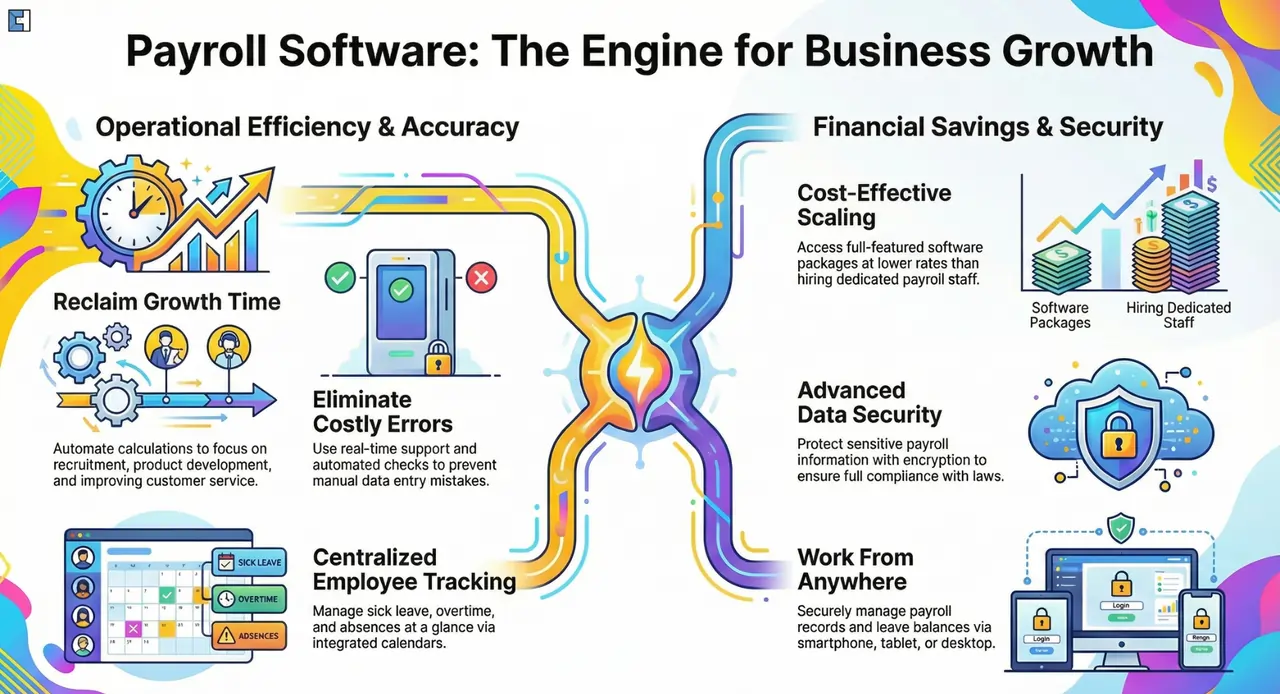
The employee calendar feature, mostly available in payroll software, allows employers to manage sick leave, overtime, and absence in real time. Employers can see leave details at a glance, including the number of leave days employees are entitled to and the type of leave they are currently on. It helps you manage a growing team and their schedules for better project planning.
Data Security
For a growing small business, it’s important to keep payroll data secure and in compliance with payroll regulations at all times. With payroll software, payroll professionals can leverage advanced security features to ensure payroll information is encrypted and well-protected.
Access and Work From Anywhere
The biggest benefit of having payroll software for a growing business is the remote access and device compatibility. You can manage and access remote and hybrid team information without manual clocks in an clocks outs.
Cost-Effective
Using payroll software is a cost-effective alternative to an in-house team to manage payroll. Your accountants providing payroll services can help you set up one along with your accounting software and help you manage it.
With payroll software, you access a range of features in one package at low-cost rates. Outsource your payroll to payroll accountants to further reduce the cost of running a department.
Avoid Costly Mistakes
Payroll software significantly reduces errors by automating calculations and providing compliance checks, ensuring accurate payroll records and payslips. This automation minimises the risk of human error and helps businesses stay current with tax and labour laws.
Learn how Bacs payments work in this quick guide.
Save time
Payroll software helps small businesses save time on payroll tasks. You spend less time calculating payroll and more time expanding your business by hiring employees, creating new products, or offering better customer service.
Regular Reminders
Most payroll software makes it easy to set reminders for payroll deadlines so you can avoid missing payroll tax returns and other payroll tasks.
We have compiled an in-depth comparison of the top payroll and accounting software for small businesses so you can choose the most suitable for your business.
Best Payroll Software for Small Businesses in the UK
Conclusion
You’ve now understood how to use payroll software for a growing small business in the UK. As a business owner in the UK, you must not overshadow HMRC’s payroll compliance requirements. If you don’t have time or are unable to manage payroll on your own, you can outsource payroll systems to professional payroll service providers to handle your payroll system with great care and attention.
Additional Resources: