


















































Investment tax relief refers to tax benefits available to eligible investors who invest in qualifying companies or schemes. In the UK, the Enterprise Investment Scheme (EIS) and Seed Enterprise Investment Scheme (SEIS) offer tax relief to eligible investors in qualifying companies, while Venture Capital Trusts (VCTs) offer relief to eligible investors who subscribe for qualifying shares in a Venture Capital Trust.
For startups, SEIS and EIS can help attract funding by making investment more appealing to eligible investors. The relief available depends on the scheme, the investor’s tax position and the relevant eligibility conditions.
EIS vs SEIS vs VCT: Comparison of UK Investment Tax Reliefs
| Feature | SEIS | EIS | VCT |
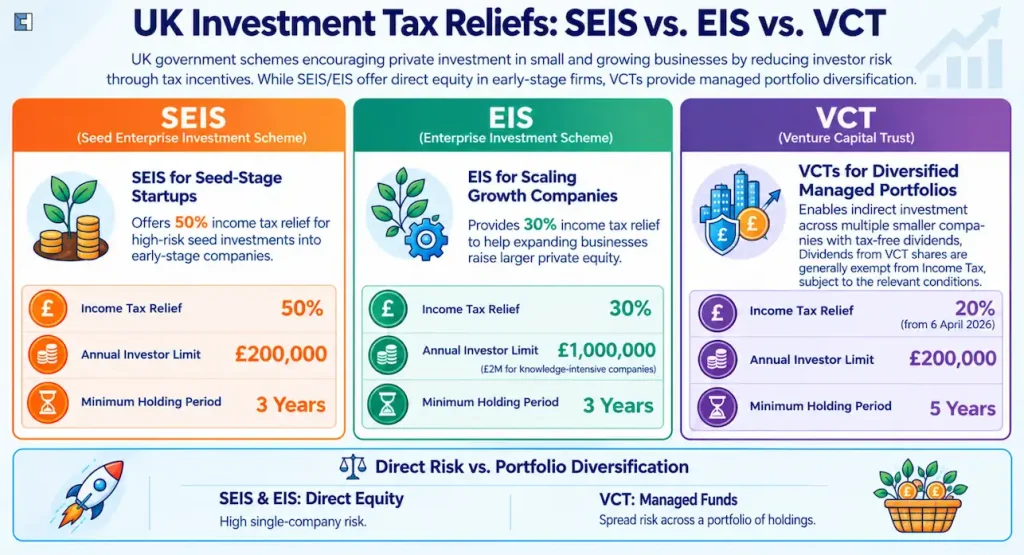
| Investment Type | Direct investment in qualifying early-stage companies | Direct investment in qualifying companies | Investment in a VCT that invests in a portfolio of qualifying companies |
| Main Investor Benefit | Up to 50% Income Tax relief | Up to 30% Income Tax relief | 20% Income Tax relief (for qualifying shares issued on or after 6 April 2026) |
| Maximum annual qualifying investment per investor | £200,000 per tax year | £1 million per tax year; up to £2 million if the excess is invested in Knowledge-Intensive Companies (KICs) | £200,000 per tax year |
| Minimum Holding Period | Generally 3 years | Generally 3 years | Generally 5 years |
| Business Stage | Very early-stage companies | Qualifying early-stage and growth-focused companies | Portfolio of smaller qualifying companies |
| Capital Gains Tax Treatment | Qualifying share disposals may be exempt from CGT; reinvestment relief may also apply under the relevant rules | Qualifying share disposals may be exempt from CGT; CGT deferral relief may also apply under the relevant rules | Gains on qualifying VCT share disposals are generally exempt from CGT |
| Loss Relief | Income Tax loss relief may be available on qualifying losses | Income Tax loss relief may be available on qualifying losses | No equivalent Income Tax loss relief is available |
| Risk | High/very high risk due to exposure to early-stage businesses | High risk due to exposure to smaller qualifying companies | High risk; diversification does not eliminate investment risk |
These are investor limits, not company fundraising limits. All reliefs depend on the applicable eligibility conditions and the investor’s tax position.
Example: Potential tax relief on a £10,000 investment
A qualifying £10,000 investment could provide up to £5,000 in SEIS Income Tax relief, £3,000 in EIS relief or £2,000 in VCT Income Tax relief for qualifying VCT shares issued on or after 6 April 2026. These are illustrative maximum amounts, not guaranteed refunds. Actual relief depends on eligibility and the investor’s available Income Tax liability.
Enterprise Investment Scheme (EIS) Tax Relief
The EIS is a UK tax relief scheme that encourages individuals to invest in qualifying companies. Eligible investors can generally claim 30% Income Tax relief and must generally hold the shares for at least three years to retain the relief.
EIS improves access to private investment for smaller companies, while providing eligible investors with relief when they invest in qualifying companies.
EIS compliance involves strict HMRC requirements, and failing to meet them can affect an investor’s ability to claim tax relief. Our guide covers the key compliance steps businesses need to understand.
Seed Enterprise Investment Scheme (SEIS) Tax Relief
The Seed Enterprise Investment Scheme (SEIS) supports early-stage startups by offering tax incentives to investors who subscribe for new shares in qualifying companies.
For founders, SEIS makes the investment proposition more appealing to investors seeking significant relief for investing in higher-risk startup businesses. Eligible investors can generally claim 50% Income Tax relief and must generally hold the shares for at least three years to retain the relief.
Many startups struggle to understand whether they qualify for SEIS and how the scheme works before approaching investors. Our detailed guide explains the eligibility rules, benefits, and application process in more detail.
Venture Capital Trust (VCT) Tax Relief
A Venture Capital Trust (VCT) is a listed investment company that provides a range of investment opportunities in small, high-risk businesses. Unlike SEIS and EIS, where investors buy shares in qualifying businesses, VCT investors buy shares in the trust itself.
VCTs are designed to support and promote investment in growing businesses while offering eligible investors potential tax relief under HMRC rules.
How Does VCT Tax Relief Work?
For qualifying VCT investments, investors can receive Income Tax relief of 20% of the amount subscribed for qualifying shares (applicable to shares issued on or after 6 April 2026), subject to the relevant conditions and the £200,000 annual investment limit.
Qualifying VCT dividends are generally exempt from Income Tax, while gains on the disposal of qualifying VCT shares are generally exempt from Capital Gains Tax.
Investors generally need to hold the VCT shares for at least five years to retain the Income Tax relief. If you sell, transfer, or redeem your VCT shares before the 5-year period is complete, HMRC will claw back 100% of the upfront Income Tax relief you claimed.
Other Tax-Efficient Options
ISAs can offer tax-free interest, investment income and capital gains within the account rules. Pensions offer tax relief on eligible contributions, subject to applicable limits, with tax potentially payable on withdrawals.
Unlike ISAs and pensions, which provide tax advantages through savings, investment income, gains or pension contributions and withdrawals, EIS, SEIS and VCT reliefs are linked to qualifying investments and specific scheme conditions.
EIS, SEIS, and VCTs are among the most recognised tax-efficient investments in the UK, alongside ISAs and pensions.
Tax Relief When Selling Qualifying Investments
Investors’ Relief is a Capital Gains Tax relief that allows eligible investors to pay a reduced rate of 18% CGT (on qualifying disposals, subject to a £1 million lifetime limit) when they dispose of qualifying shares in eligible companies, subject to specific conditions. Business owners and founders may also wish to review Business Asset Disposal Relief (BADR), which has separate eligibility rules.
Risks and Considerations Before Using Investment Tax Reliefs
Although SEIS, EIS, or VCT schemes are designed for higher-risk investments, these schemes will not eliminate the risk of losing the investment. Potential returns depend on the performance of the investment portfolio or business.
Investors generally need to meet the minimum holding period and other scheme conditions to retain relief. Selling shares too early or failing to meet ongoing conditions can reduce or withdraw relief. Meeting the minimum holding period does not guarantee an exit or protect against investment losses.
UK investment tax relief schemes are subject to changes in tax rules, government policies, and HMRC updates. Businesses and investors should ensure they use up-to-date information when selecting investment opportunities.
Which UK Investment Tax Relief Is Right for You?
Choosing the right UK investment tax relief depends on factors such as your investment objectives, risk appetite, desired level of involvement, and whether you want direct exposure to individual businesses or a diversified investment approach.
- SEIS: May suit investors considering very early-stage businesses, with potential Income Tax relief of up to 50%. These investments carry significant risk and can be difficult to sell.
- EIS: May suit investors considering qualifying early-stage and growth-focused companies, with potential Income Tax relief of up to 30%. Shares may be difficult to sell, and investors must meet the relevant holding-period conditions to retain relief.
- VCT: May suit investors seeking exposure to a portfolio of smaller businesses through a listed investment company, with potential Income Tax relief of 20% on qualifying shares for issues from 6 April 2026 onwards. VCT shares can fluctuate in value and may be difficult to sell at the desired price.
The highest relief percentage does not automatically make an investment the best choice. Investors should compare the risks, access to their money, holding-period requirements and their own tax position before investing.
- For a more informed decision, our guide will help you analyse IR, ER, SEIS Vs EIS: Find the Best Investment Relief for You
What Startups Raising SEIS or EIS Funding Need to Know
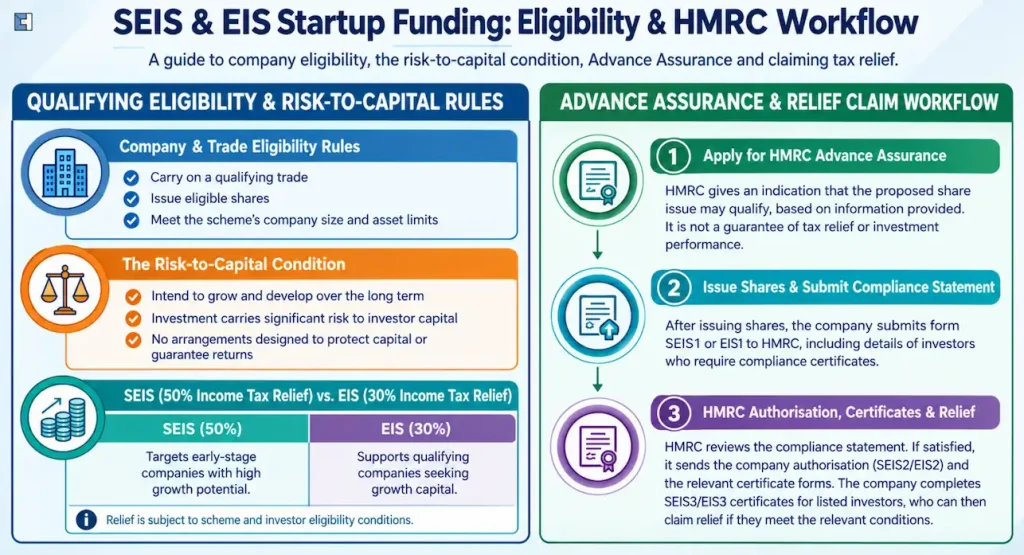
Startups must meet the relevant company, trading and share-issue conditions to raise funding through SEIS or EIS. Founders should review the eligibility rules and compliance requirements before approaching investors and consider applying for HMRC advance assurance, which can help demonstrate that a proposed investment may qualify but does not guarantee relief.
Company fundraising limits are separate from investor limits. SEIS-eligible companies can generally raise up to £250,000 over their lifetime. Under EIS, most companies can raise up to £10 million in any 12-month period and £24 million over their lifetime. Qualifying knowledge-intensive companies may be eligible for higher limits of up to £20 million in a 12-month period and £40 million over their lifetime. Different limits apply to certain specified companies, so businesses should check the relevant HMRC eligibility rules.
Startups raising SEIS or EIS investment may also need support with eligibility, financial planning, compliance and investor readiness. Our team of Startup Accountants can help businesses prepare for fundraising and manage these financial requirements.
How Do Investors Claim Tax Relief in the UK?
Investors can claim EIS or SEIS Income Tax relief after receiving the relevant compliance certificate, such as EIS3 or SEIS3. Depending on the tax year and circumstances, they may claim through Self Assessment or request an adjustment to their PAYE tax code or payments on account. This normally involves:
- Obtaining the SEIS3/EIS3 compliance certificate.
- Verifying the investments made.
- Making the claim through the applicable HMRC process.
- Retaining the compliance certificates and supporting records in case HMRC requests them.
VCT investors should follow the applicable HMRC claiming guidance and retain their VCT tax certificate. Relief may be reduced or withdrawn if the relevant conditions are not met or the investment is disposed of too early.
Conclusion
UK investment tax relief schemes, including SEIS, EIS, and VCTs, can be advantageous for tax purposes and for investing in developing companies. SEIS generally targets qualifying very early-stage companies, EIS targets qualifying early-stage/growth companies, and VCTs provide portfolio exposure through a listed investment vehicle. Tax relief cannot eliminate the risk of losing capital, so investors should assess the risks and eligibility conditions before investing.
Additional Resources:
FAQs
How much tax relief do you get on EIS investments?
A maximum of 30% tax relief is available on eligible qualifying EIS investments based on rules and eligibility set forth by HMRC.
Are EIS, SEIS and VCT tax relief rules subject to change?
Yes, EIS, SEIS and VCT tax relief regulations can change due to government policy and HMRC updates. Before investing, businesses and investors should review the latest guidance to confirm current eligibility requirements, limitations, and overall relief.
Can investors claim loss relief on SEIS and EIS investments?
Yes, you can claim loss relief on SEIS and EIS investments under the right circumstances and in accordance with HMRC regulations.
Can investors claim tax relief on VCT investments?
Eligible investors may claim Income Tax relief on qualifying VCT share subscriptions, subject to the applicable conditions and limits. Qualifying VCT dividends are generally exempt from Income Tax, and gains on qualifying VCT share disposals are generally exempt from Capital Gains Tax.