



















































If your business goes over the VAT threshold and you don’t register, the consequences can be expensive.
You may have to pay VAT you didn’t charge your customers, plus interest and penalties from HMRC.
In this guide, we explain exactly what happens if you don’t register for VAT, how far back HMRC can go, and how to fix the issue.
If you don’t register for VAT when required:
- You must pay VAT from the date you should have registered
- You may face penalties based on how late you are
- HMRC can charge interest on unpaid VAT
- You must submit backdated VAT returns
- You may have to pay VAT out of your own profits if you didn’t charge customers
If you fail to register for VAT with HMRC, you’ll face penalties. These penalties will depend on the amount of VAT you owe and the length of time you have been late in registering. The penalty is calculated as a percentage of the VAT due (output tax – input tax) from the date you should have registered to the date you actually registered.
If you don’t register for VAT on time, it means you haven’t charged VAT on taxable goods and services from your customers. You still need to pay the VAT that should have been charged, even if you did not collect it from your customers. If you still haven’t registered and are eligible, you can consult VAT registration services providers.
When Do You Need to Register for VAT?
You must register for VAT if your taxable turnover exceeds £90,000 in any rolling 12-month period. This is not based on your accounting year or the tax year.
Once you exceed the threshold:
- You must notify HMRC within 30 days of the end of the month
- Your effective date of VAT registration is the first day of the second month after you crossed the threshold
Example:
If your turnover exceeds £90,000 in July, you must register by 30 August, and VAT applies from 1 September.
How HMRC Discovers Late Registration?
Compliance checks and risk-based enforcement help HMRC to identify late VAT registrations. These checks are performed via:
- Data analytics and cross-matching with information from other government sources (e.g. Companies House filings, PAYE, Corporation Tax or Self Assessment returns, bank data, or VAT returns). Often visualised using a chart creator to identify discrepancies and patterns.
- Routine audits, site visits, or when you contact HMRC for any other reason.
- Third-party reports or intelligence.
If you disclose the issue after HMRC discovers a late VAT registration, it’ll be treated as a prompted disclosure. On the other hand, if you come forward yourself before HMRC suspects you, it’ll be an unprompted disclosure, and you’ll be levied lower penalties.
How Far Back Can HMRC Charge VAT?
Typically, HMRC charges under-declared VAT for up to 4 years from the end of the relevant tax period. However, this time frame can extend to 6 years for careless errors and up to 20 years if HMRC proves deliberate tax evasion or fraud. For offshore issues related to offshore transfers, the limit can be up to 12 years.
Better practice is to make a voluntary disclosure to HMRC if you find out errors, as this often results in lower penalties than if HMRC discovers the issue.
Backdated VAT Liability Example
As you know, the VAT threshold as of 2026 is £90,000 taxable turnover in any rolling 12-month period. Suppose your taxable turnover exceeds £100,000 at the end of July 2024 (based on the previous 12 months).
- You should notify HMRC by 30 August 2024.
- Effective Date of Registration (EDR): 1 September 2024
If HMRC finds out in March 2026 that you made £200,000 in sales and had £50,000 in purchases eligible for VAT reclaim between September 1, 2024, and December 31, 2025, your liability would be:
Liability
- Output VAT due: £40,000 (20% of £200,000)
- Input VAT reclaimable: £10,000
- Net VAT payable: £30,000 (plus interest from the original due dates)
- You must also submit VAT returns (or HMRC will assess them) for every period from 1 September 2024 onwards.
- On top of the £30,000, you will face a failure-to-notify penalty calculated as a percentage of the £30,000 (potential lost revenue).
If you had registered on time, you would have charged your customers VAT from September 2024 and reclaimed input VAT. In that case, the VAT liability is paid out of your own revenue, directly reducing your profit margins.
So the total cost to you is not just the late-payment interest and penalty, but also the commercial impact of absorbing the VAT.
Get professional VAT advice with our trusted small business accountants!
How to Fix the Situation Step-by-Step
Here’s what you can do to fix the situation:
- Work out exactly when you first became liable
- Register for VAT immediately online at gov.uk/register-for-vat
- Check if, in your specific scenario, HMRC can backdate your registration to the correct EDR
- Calculate and declare the backdated VAT
- Deal with the penalty
- Make an appeal if necessary, and if you have a reasonable excuse
- Consult an expert VAT Accountant.
Penalties for Not Registering for VAT
In addition to paying a penalty for late VAT registration, you may be charged with a penalty for failing to notify HMRC of the correct time to be registered for VAT. If HMRC believes you’ve committed deliberate tax evasion, you could face a civil evasion penalty too.
Stay Ahead on VAT: Business Guides and VAT Schemes Explained
The minimum penalty is £50. This rate of penalty depends upon how late you register:
| How late was your VAT registration? | The penalty |
| Nine months or under | You will owe 5% of PLR(Potential Lost Revenue), in addition to what was originally due. |
| Between nine and 18 months late | On top of the amount you owe, an additional 10% of PLR. |
| Over 18 months | An additional 15% of what you owe, on top of your regular payment |
When you incur a penalty, HMRC will notify you in writing. If you think you should not be penalised or there’s a wrong amount of penalty, you can make an appeal to HMRC.
Reasonable Excuses for Forgetting to Register for VAT
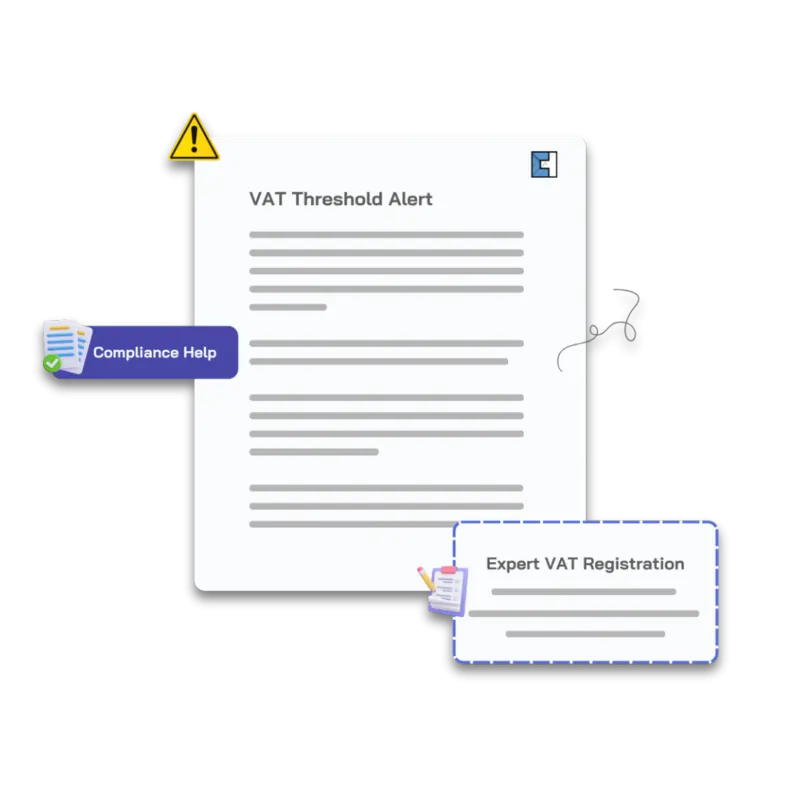
Did you know that if special circumstances arise, HMRC may agree to waive the penalties?
These are called ‘reasonable excuses’ and can be classified as either out-of-your-control events or unexpected occurrences. So what might be considered a reasonable excuse for forgetting to register for VAT?
For example:
- Serious illness of a family member or your severe sickness
- Bereavement close to the time of required registration
- An authentic problem with HMRC’s online services
- A significant and unforeseen disruption to your business (e.g. fire, flood, or theft of records).
Dealing with HMRC can be intimidating, especially if you’ve made a mistake or failed to comply.
Additional Resources
Final Thoughts
If you have not registered for VAT, or if you’re unsure about how the system works, it’s best to seek professional help to ensure you don’t make any costly mistakes. Late VAT filing and payment can result in severe penalties, so it’s important to stay on top of your obligations.
If you have any questions about VAT or need professional VAT services, please don’t hesitate to book a meeting. We would be happy to help!
FAQs
Is VAT registration compulsory?
You need to register for VAT if your taxable turnover for the previous 12 months reaches the registration limit. You must also check the total turnover for the past 12 months.
How far back can you register for VAT?
Voluntary registration can be made for a period of no more than four years from the date the application is received. Compulsory VAT registration is made when the liability arises.
Can I reclaim the VAT back if my turnover is less than £90,000?
Only VAT-registered businesses, and those who charge it, can reclaim it.
Can I charge VAT if I am not registered for VAT?
No, you can’t charge VAT if you are not VAT-registered with HMRC. If you are not VAT-registered and charge VAT, it’ll be considered illegal, and you may be penalised up to 100%.
What to do if I have missed a VAT registration deadline?
If you’ve missed the deadline when you should have registered, register immediately, submit all due returns, pay due VAT, and face potential penalties.
How to avoid missed VAT registration penalties?
To avoid VAT registration penalties, register within 30 days of exceeding the VAT threshold, maintain accurate records, submit the returns on time, use MTD software, and get help from an accountant.